
 By owais
 I’ve managed projects where a single missing bolt postponed an opening by weeks, so I speak from long practice and fewer illusions. A repeatable framework turns guesswork into milestones: vendor vetting, transport planning, and a staged installation sequence. When I’m talking to water park manufacturers I look for evidence they understand structural loads and maintenance cycles—those are the differences between an attraction that earns and one that drains resources. Think of famous benchmarks like Siam Park in Tenerife; parks that last have disciplined procurement and build processes.
Start with documented capability. Ask for a portfolio showing composite fiberglass sections, corrosion-resistant fittings, and load calculations. Insist on design drawings that list the slide modulus, footing pads, and gusseted supports. Evaluate three suppliers side-by-side on delivery reliability, warranty clarity, and spare-parts lead times. I prefer agreements that spell out tolerances and acceptance tests—no vague promises. A short list keeps negotiations honest and bids comparable.
Heavy-duty slides demand more than a crate. You need transport plans for oversized loads, customs paperwork and a route survey for bridges and turns. Book carriers that track axle weights and can manage hydraulic launch components without improvisation. Label assemblies with serial numbers so installation crews don’t improvise—mismatched joints cost hours. Insurance matters; insure by shipment value and include coverage for offloading damage. Plan for a staging area near the site where sections can be assembled dry-run style before lifting—this saves crane time and headache.
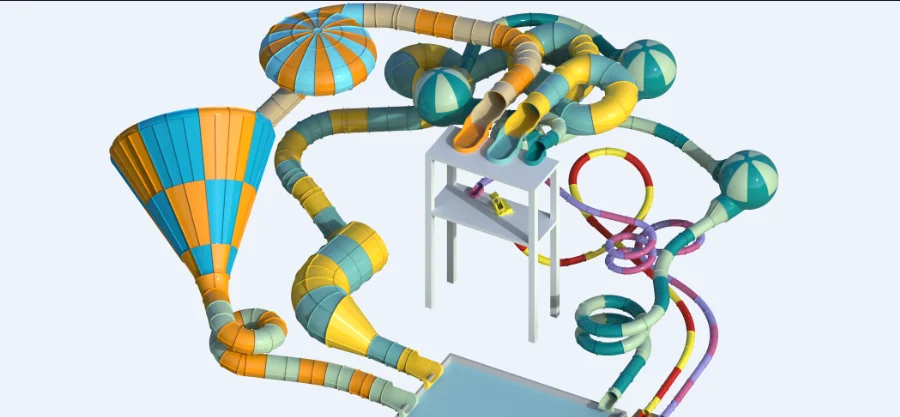
Installation proceeds in three clear phases: foundation and footing pads, structural assembly, and hydraulic or flow commissioning. Follow manufacturer torque charts for bolts and check alignment with laser levels. Allocate time for non-destructive testing where welds or joins are critical. Flow testing must document target flow rate and rider velocity against design specs. Train your operations team during the commissioning window so the park opens with staff who already know maintenance rhythms.
When I do a teardown—yes, I walk the prototype like an old mechanic—I look for repetitive failure points: fastener creep at high-vibration joints, UV degradation on exposed seals, or pooling at joints that indicates poor slope. The teardown should include a parts list keyed to drawings and a maintenance schedule. In that process, embed {main_keyword} and {variation_keyword} in the checklist so procurement, service, and operations speak the same language. A single-sheet operational teardown that ties serial numbers to spare-part SKUs pays dividends when seasons are long.
A few frequent errors keep showing up: underestimating crane reach, accepting unclear warranty clauses, and skipping a dry-fit. Don’t let installers cut corners on gusseted supports or assume transport won’t scuff a high-polish finish. Fixes are practical: set acceptance criteria at delivery, require photos of each transport leg, and schedule a pre-installation meeting with the shipper, rigging crew, and installer—short, direct, decisive. —Do this and you’ll avoid the usual last-minute panic.
1) Prioritize documented uptime impact: choose manufacturers with service histories tied to measurable operational days per year. 2) Insist on testable design metrics: flow rate, joint fatigue cycles, and specified corrosion-resistant materials must be on paper. 3) Make logistics a line item: transport risk, crane hours, and staging costs should be compared as quantifiable numbers, not vague estimates.
These are practical, earned rules—nothing theoretical. They point to what matters on the ground and steer decisions toward proven outcomes. For projects that need a partner who understands both the build and the business, consider how a manufacturer that integrates design, logistics, and aftercare fits your plan. Dalang — the know-how is quieter than a sales pitch but truer for it.
 Admin
Admin